As if in veins, flows of color
the MYRRHITE crystal arrests, flare
purple into white,
lilac, pink, pale gold.
From the spoils of war,
it was you Pompey set aside.
CARCHEDONIA, made
by divine rain the
Nasamones—indigenous people who trade
with Carthage—(hence the name)—
say. Find the stones when the moon
is full. They reflect only moonlight.
ASTERIA. Tilt the stone, the light within it—
‘stored in something,’ Pliny says, ‘like the pupil
of the eye’—moves; leaps place to place, dis-
continuous, at different angles to the sun.
Candescent prisoner pent; held up direct
to the sun becomes ‘sun in other form.’
OPAL, you in whom
converge carbuncular
fire, purple
amethyst-flash and smaragdus’
sea-green sheen—you mineral magic
lantern.
HELIOTROPE, bloodstone, green
jasper or translucent chalcedon spattered cherry red
Albertus Magnus called Stone of Babylon
Pliny says predicts eclipses
Gnostics say dispels melancholy
Christians say is dashed with Jesus’ blood.
CALLAINA, turquoise Pliny says
is found in the blackcap’s nest,
Marco Polo found in Sichuan.
See also the priestly breastpiece
in Exodus 28; see also the face
of Xiuhtecuhtli, God of Fire.
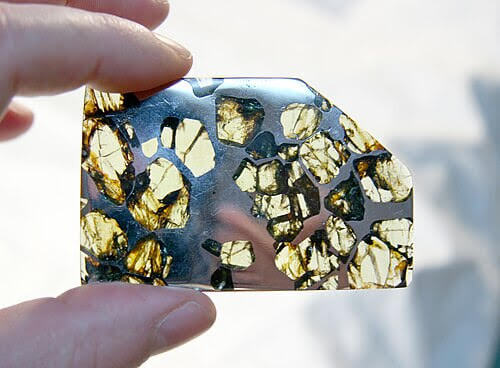
PERIDOT, prasoides, leek-like, or
chrysopteros, golden-winged—its
iron tints green light brown or gold—
troglodytes, digging among roots, un-
earthed; in 1951 was found aglow
like God’s mind inside the Esquel Pallasite.
MELICHRYSUS and LEUCOCHRYSUS,
corundums honey-gold, and white-gold
veined white. Porcelain or pure honey
viewed through clear gold film.
Hard enough to scar
nearly any other gem; also used in nail files.
Legend says LYNCURIUM comes from lynx urine. The cats,
‘bearing a grudge toward mankind’—thus sardonic
Pliny, whose sources said it cured the sick by sight—
bury it. It hardens in the earth. Or, says one
Lawrence Andrewe (1521), the ‘pisse
baketh in ye sonne, and that becommeth a ryche stone.’
My birthstone the SAPPHIRE, corundum
like its sibling the ruby but colored blue due
to an intervalence charge transfer
of iron and titanium ions which absorbs
electromagnetic energy from the yellow part
of the spectrum, yielding its complement, blue.
CHRYSO—Greek for gold; PRASE—Greek
for leek: a green-gold chalcedony with a waxy
luster. PLASMA: the same thing but ‘between
grass green and leek green and sometimes
approaching pale mountain green . . . its lustre
glistening inclining to glimmering’ (R. Jameson, 1816).
The top four varieties of IASPIS are:
1) the one that has a shade of purple;
2) the one that has a shade of rose;
3) the one that resembles smaragdus
and 4), the BORIA, named for the north wind
because it has the color of an autumn morning sky.
LYCHNIS, lucernarum accensu, Atargatis’
red headlamp: its phosphorescence lights
the inner sanctum in Hierapolis Bambyce,
but the stone’s flattered best by that part of dusk
when candles are lit. Hence the name.
Today Manbij has largely been destroyed.
AVENTURINE, green
stone, whose body’s
mineral-flecked, but not so as to disturb
its surface sheen. ‘Aventurescence’
means:
stars within the stone.
CARBUNCLE, flamelike
gem—you whose red
passes, edgewise
into violet; whose red
shines, from deep
in your core.
At Actium, Agrippa used the harpax,
a catapult-shot grapnel, to harpoon
and haul Antony’s ships close
so as to board them. Thereafter triboelectric
AMBER—rub it, it picks up lint, cat hair,
loose thread—they call harpax.
LAPIS LAZULI fills
Titian’s magnificent
Bacchus and Ariadne’s sky,
and rings King Tut's
and Cleopatra’s eyes;
pyrite-flecked handful of night.
Crazy Lace AGATE from Chihuahua
aswirl, its red and yellow and white
bands and zigzags, its waves
of Argus eyes like boils, or bubbles
in the visual liquid of the stone.
Yet you’d need a strong back to carry it.